
The Right Cleaning Program Depends on What Routine Maintenance Cannot Address.
Businesses comparing janitorial services in Scottsdale AZ with specialized deep-cleaning programs should first recognize that the two approaches solve different problems. Routine janitorial work is designed to maintain acceptable cleanliness and hygiene through recurring tasks, while deep cleaning addresses areas that require more intensive attention due to accumulated soil, neglected surfaces, operational changes, or specific facility conditions. Health Point Cleaning Solutions provides commercial janitorial services tailored to the needs of different commercial environments, rather than treating every facility as identical.
The better choice is not necessarily one service over the other. In many commercial properties, routine cleaning provides the foundation, while periodic deep cleaning addresses tasks that are impractical to perform during every scheduled visit. The comparison should therefore focus on facility type, traffic, surface conditions, hygiene expectations, operating hours, and the level of cleaning already being provided.
Routine Janitorial Work Handles the Conditions a Facility Creates Every Day
Routine janitorial services primarily focus on maintaining the building as it is used. Office spaces, shared areas, restrooms, entrances, breakrooms, and other frequently occupied spaces generate recurring cleaning needs that cannot reasonably be postponed until a deep-cleaning appointment. Dust, tracked-in soil, overflowing trash receptacles, restroom use, fingerprints, food residue, and general surface debris all accumulate through normal operations.
Typical recurring tasks may include vacuuming carpeting, dusting, floor care, emptying trash receptacles, cleaning high-touch surfaces, and maintaining toilets and urinals. The precise schedule depends on the facility type and level of use. A busy office near Scottsdale Airpark may require a different routine from a smaller professional office with fewer employees and less daily traffic.
Routine service also provides consistency. Instead of allowing visible dirt or sanitation issues to accumulate until a facility needs a major cleaning, recurring maintenance keeps conditions under control. A day porter can provide additional support in facilities where common areas, restrooms, entrances, or other high-use spaces need attention during operating hours.
Traffic and Facility Type Should Influence the Comparison
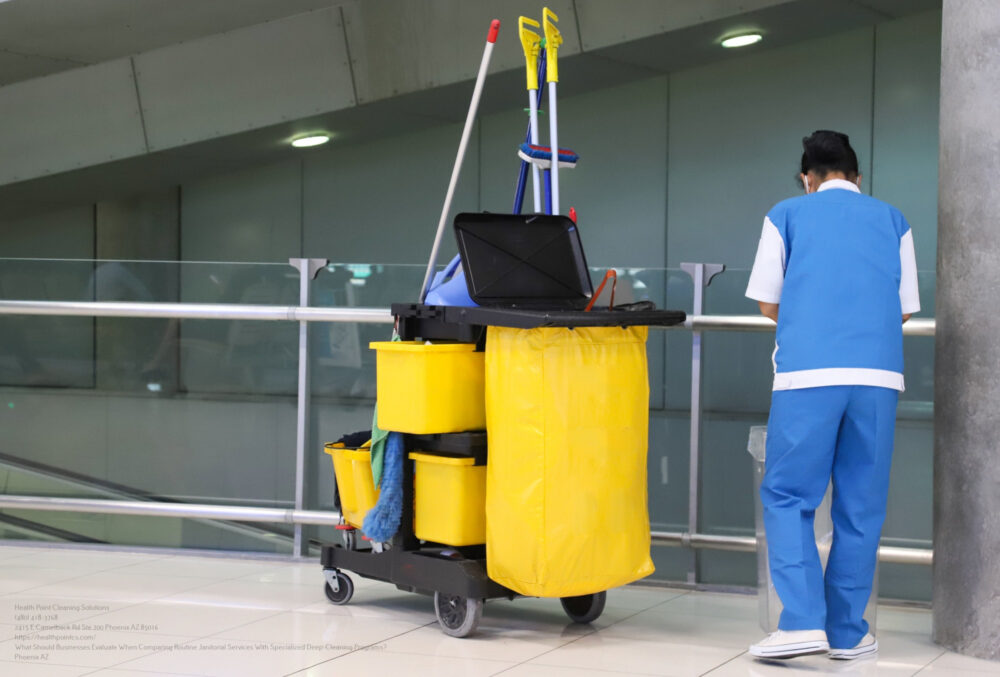
A business should evaluate the level of activity the property receives before deciding how much routine or specialized cleaning is necessary. High-traffic areas generally accumulate soil and contact-related contamination faster than spaces that remain lightly occupied. Entranceways, shared work areas, elevators, breakrooms, restrooms, and reception areas may therefore require more frequent attention.
The Centers for Disease Control and Prevention recommends regularly cleaning high-touch surfaces and notes that high-traffic spaces may require more frequent cleaning. It also distinguishes routine cleaning from disinfection and recommends cleaning surfaces before disinfecting them because dirt and other impurities can interfere with disinfectant effectiveness.
The facility’s purpose matters as well. A conventional office, retail property, educational facility, or industrial setting can have different cleaning priorities because each environment has different surfaces, occupancy patterns, equipment, and hygiene expectations. A customized cleaning plan should reflect those conditions instead of assigning the same frequency and task list to every room.
Looking for Professional Janitorial Services?
Contact the team to discuss cleaning priorities and develop a practical service plan for the facility.
Deep Cleaning Addresses Conditions that Routine Visits May Not Reach
Deep cleaning becomes more valuable when normal maintenance cannot adequately address accumulated buildup or less accessible areas. A recurring cleaning crew may regularly vacuum carpeting and clean visible floor surfaces. However, periodic intensive work may still be needed for edges, corners, grout, upholstery, high surfaces, or other areas that receive less attention during routine visits.
Tile & grout is one example. Regular floor maintenance can remove everyday soil from the surface, but grout lines can gradually collect residue that requires a more detailed cleaning technique. The same principle applies to areas behind or beneath furniture, difficult-to-reach fixtures, and surfaces that are cleaned less frequently because they do not affect the office’s immediate appearance.
Deep cleaning can also become appropriate after changes in building use, prolonged occupancy, renovation, or other circumstances that introduce additional cleaning demands. Post-construction cleaning, for example, addresses a different condition from ordinary office maintenance because construction dust and residue can settle throughout a property. That type of work should not be treated as simply another routine janitorial visit.
Hygiene Requirements Can Change the Role of Specialized Cleaning
Cleanliness and hygiene are related but not identical. A surface can appear clean yet still require attention due to frequent contact, recent contamination, or a facility-specific sanitation requirement. Routine cleaning removes dirt and many germs from surfaces, while Disinfection is intended to kill remaining harmful germs after cleaning. The CDC recommends disinfecting after people have obviously been ill and emphasizes following product instructions for safe and effective use.
This distinction matters when businesses compare standard janitorial work with Disinfection Services or other specialized cleaning options. A business should identify the reason for additional Disinfection rather than assuming that every surface requires aggressive chemical treatment every day. In some circumstances, targeted cleaning and disinfecting services may be more appropriate than applying a broad treatment throughout the entire property.
Electrostatic Disinfection also requires careful evaluation. Therefore, businesses should evaluate any specialized disinfection method based on the intended use, product instructions, surface compatibility, and applicable facility requirements, rather than selecting a technique simply because it sounds more advanced.
Product Selection Matters More Than a “Stronger” Cleaning Approach
A specialized program should not automatically mean stronger chemicals or more aggressive cleaning. The appropriate cleaning product depends on the material being cleaned, the type of soil present, the desired result, and any facility restrictions. Sensitive surfaces, finished flooring, electronics, and other materials can respond poorly to unsuitable products.
Businesses interested in eco-friendly products or green cleaning should evaluate whether the selected products are appropriate for the tasks involved. Non-toxic, locally made natural products may meet certain cleaning goals, but environmental positioning alone does not guarantee a product is suitable for every surface or hygiene requirement.
The same principle applies to cleaning techniques. A dust mop may be appropriate for collecting surface debris in one area, while vacuuming may be better suited to carpeting. A restroom may require different products and procedures from an office workstation. The strongest cleaning program is therefore based on matching the method to the condition rather than assuming that a single product or technique should be used throughout the building.
Cost Comparisons Should Include Frequency, Scope, and Disruption
Businesses often compare routine janitorial service and deep cleaning by looking only at the immediate price. That can produce an incomplete assessment because the services are designed for different frequencies and purposes. Routine work is recurring and generally covers predictable maintenance tasks, while deep cleaning involves a broader or more intensive scope that may be scheduled periodically or triggered by specific conditions.
Operational disruption should also be considered. Some deep-cleaning tasks may require that areas be temporarily unavailable, furniture be moved, or work be scheduled outside normal business hours. A routine program may create less disruption because tasks are spread across regular visits.
A useful comparison should therefore consider the total cleaning strategy. A facility may find that consistent routine service, combined with periodic deep cleaning, provides better control than relying on infrequent intensive cleaning to correct accumulated conditions. The right balance depends on occupancy, surfaces, facility type, cleanliness standards, and operational requirements.
Staffing and Service Consistency are Part of the Evaluation
The quality of a cleaning program also depends on the provider’s ability to maintain consistent service. Businesses evaluating janitorial providers may want to understand how cleaning staff is selected, trained, supervised, and assigned. Screening practices, background checks, staffing processes, and clear communication can matter particularly when cleaning employees work in occupied office spaces or handle access to commercial properties.
Operational organization can also influence consistency. Systems involving client notes, scheduling, online booking, service documentation, or dedicated customer support can make it easier to communicate changes in cleaning priorities. However, businesses should evaluate these features based on whether they improve actual service coordination rather than choosing a provider simply because it offers more administrative tools.
Health Point Cleaning Solutions can be considered within this broader evaluation because a commercial cleaning relationship involves more than the individual tasks performed during a visit. Clear communication about facility conditions, priorities, scheduling, and service expectations helps establish a cleaning program that adapts as the property changes.
A Practical Comparison Should Start With the Facility’s Current Condition
Before selecting routine janitorial services, deep cleaning, or a combination of both, a business should identify what the existing program handles well and where problems remain. A facility that consistently looks clean but has neglected grout, difficult-to-reach areas, or periodic buildup may need targeted deep cleaning rather than a completely different daily program.
Conversely, a property that repeatedly develops overflowing trash receptacles, restroom concerns, dusty surfaces, or heavily soiled entryways may have a routine-service frequency problem rather than a deep-cleaning problem. Increasing the scope of periodic cleaning will not necessarily address conditions that recur every day.
The most useful comparison therefore considers the building’s actual cleaning priorities. Businesses can evaluate traffic levels, facility type, surface materials, hygiene requirements, operating hours, recurring problem areas, and the amount of disruption that specialized work would create. This produces a more practical basis for choosing between routine maintenance and periodic intensive cleaning.
The Best Strategy Often Combines Consistent Maintenance With Targeted Deep Cleaning
Routine janitorial service and specialized deep cleaning should not necessarily be viewed as competing choices. Routine maintenance keeps everyday conditions manageable, while deep cleaning can address areas and situations that require more time, equipment, or specialized techniques. A facility that combines the two can establish a cleaning strategy that reflects both daily use and longer-term maintenance needs.
For businesses seeking janitorial services in Scottsdale AZ, including properties serving busy commercial areas such as Kierland Commons and Gainey Ranch, cleaning priorities can change with occupancy, seasons, events, renovations, and business operations. Health Point Cleaning Solutions can help businesses evaluate those requirements and determine an appropriate janitorial approach. The practical next step is to compare the facility’s recurring needs with the conditions that require periodic intensive attention, then build a cleaning plan around those findings.
Looking for Professional Janitorial Services?
Contact the team to discuss cleaning priorities and develop a practical service plan for the facility.